Innovation in Practice

Research That Moves Organizations Forward

These stories are designed to help prospective clients quickly understand the innovation behind the work, why it matters, and how a similar approach could be adapted for their organization.

Dr. Ann C. Kimble-Hill, ACS Fellow
01

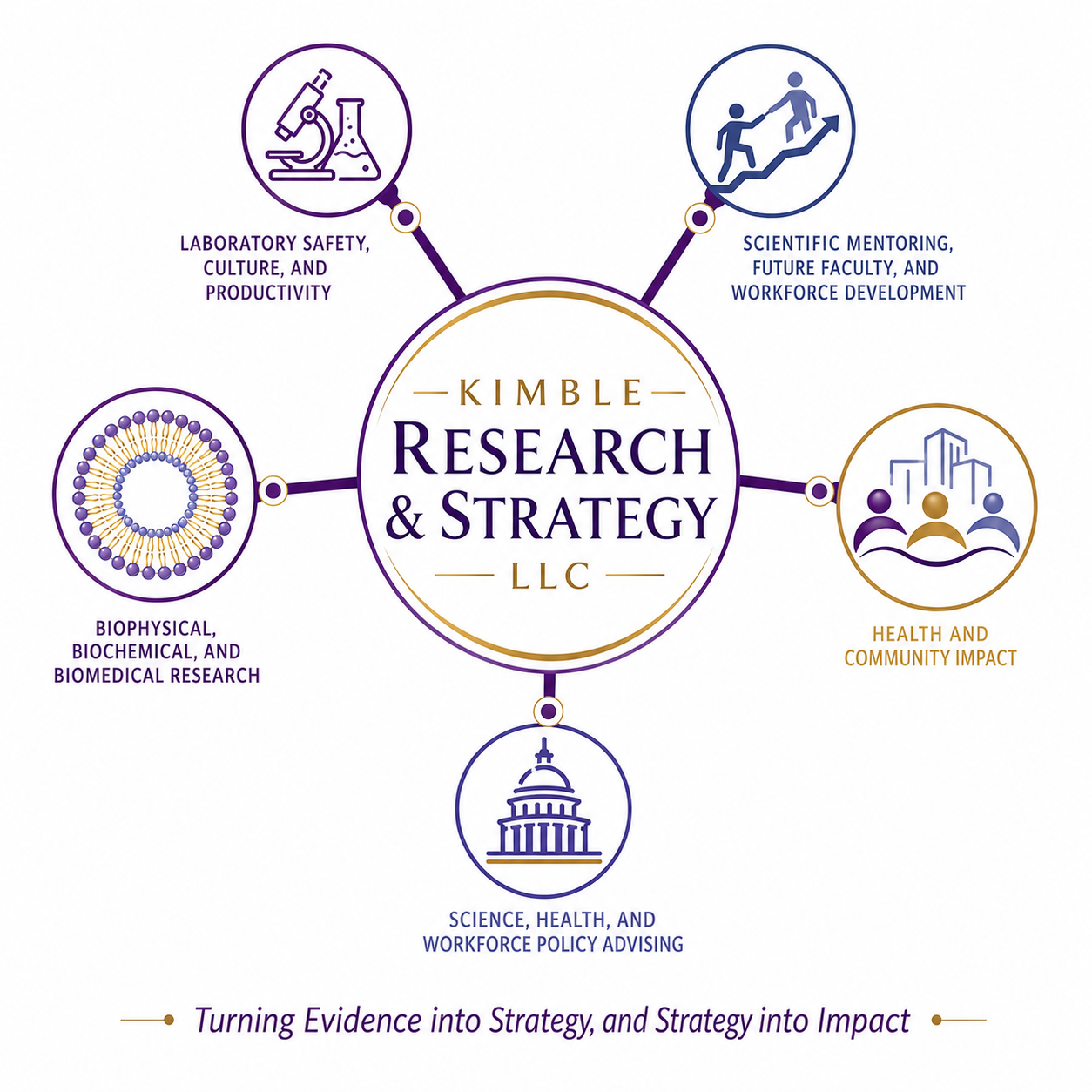
Laboratory Safety, Culture, and Productivity Optimization

Why One Bad Day in a Laboratory Can Have Lasting Effects

A laboratory can have strong safety rules and still struggle when people do not feel comfortable asking questions, reporting concerns, or challenging harmful behavior.

Our team studied what happens when biomedical trainees experience harassment, racial mistreatment, or incivility, even over a short period. We found that these experiences can shape how people feel about their careers, their workplaces, and whether they believe they can succeed in science. That means laboratory culture is not separate from safety and productivity. It helps determine whether people speak up, work together, and stay engaged.

Our broader work also brings together perspectives from researchers, safety professionals, and organizational leaders to identify practical changes in supervision, communication, reporting, and policy. The focus is not simply on whether rules exist, but on whether the day-to-day environment supports people in following them.

How this can help your organization: We help organizations identify the cultural and operational barriers affecting laboratory safety, teamwork, retention, and productivity, then develop practical steps for improvement.

This work can support

  • Laboratory climate and productivity assessments
  • Communication, supervision, and reporting reviews
  • Principal investigator and research-team development
  • Incident-response and accountability planning
  • Action plans with measurable follow-up indicators

Related work

  • Stockdale, M. S., Kimble-Hill, A. C., Mosier, A. E., Kiebler, J. M., Mildor, B. R., and Washington, D. M. (2026). Prevalence and impact of single-day events of sexual harassment, racial mistreatment, and incivility on biomedical health trainees: A mixed-methods study. Behavioral Sciences, 16(3), 380.View publication
  • Kiebler, J. M., Mosier, A. E., Wu, W., Kimble-Hill, A. C., and Stockdale, M. S. (2026). Short-term effects of harassment, racial mistreatment, and incivility (HARM) on career-derailing attitudes: An experience sampling methodology study. Behavioral Sciences, 16(2), 214.View publication
  • Browne, D. L., Dickman, R., Gallant, S. K., Kimble-Hill, A., Ménard, A. D., and Trant, J. F. (2025). Building safer laboratories by evolving culture and practice. Cell Reports Physical Science, 6(8), 102722.View publication
  • Kimble-Hill, A. C. (2021). Incorporating identity safety into the laboratory safety culture. ACS Chemical Health & Safety, 28(2), 103-111.View publication
02

Scientific Mentoring, Future Faculty, and Workforce Development

Helping Future Scientists Get More from Mentoring

Strong research training requires more than placing someone in a laboratory. Trainees also need opportunities to define their goals, understand expectations, build confidence, and prepare for the next stage of their careers.

Our team used Individual Development Plans as the starting point for ongoing mentoring conversations rather than as forms completed once a year. We connected career goals with mentor support, skill development, scientific communication, graduate-school preparation, and regular progress reviews.

The innovation was not the document. It was the structure around it. Mentors and trainees had clearer roles, conversations became more intentional, and professional-development activities were tied to each person's goals. The same model can be expanded to prepare graduate students and postdoctoral fellows for future faculty roles, including mentoring, intercultural communication, research-team leadership, and constructive feedback.

How this can help your organization: We help colleges, universities, research programs, and professional societies build mentoring systems that are structured, culturally responsive, measurable, and aligned with participant outcomes.

This work can support

  • Mentor and mentee development
  • Future-faculty preparation
  • Intercultural competency for research teams
  • Postbaccalaureate and summer research program design
  • Individual Development Plan implementation
  • Program evaluation and outcome tracking

Related work

  • Hardy, T. M., Hansen, M. J., Bahamonde, R. E., and Kimble-Hill, A. C. (2022). Insights gained into the use of Individual Development Plans as a framework for mentoring NIH Postbaccalaureate Research Education Program trainees. Journal of Chemical Education, 99(1), 417-427.View publication
03

Biophysical, Biochemical, and Biomedical Research and Translational Consulting

Connecting Lipid Behavior to Cancer Biology

Cell membranes do more than hold a cell together. They organize signals, guide proteins to the right location, and influence how cells grow, move, and respond to their surroundings.

Our team studied Angiomotin, a protein involved in controlling cell growth and movement, to understand how it recognizes and attaches to lipid membranes. By changing specific amino acids within the protein, we identified sites that were especially important for keeping Angiomotin associated with the membrane. That work connected a small molecular change with a larger effect on where the protein functions inside the cell.

We continue to approach this problem from several angles. Some projects use small-angle X-ray scattering together with computer-generated structural models to evaluate protein shape when conventional structure methods are difficult. Another combines differential scanning fluorescence and dynamic light scattering to examine protein stability, size, dimerization, and lipid-binding behavior. These uncommon assay combinations are especially useful when a question cannot be answered by one experiment alone.

Together, the article and posters show how our team moves from a difficult molecular question to a coordinated experimental strategy, then connects findings across biochemical, biophysical, structural, and cell-based studies.

How this can help your organization: We help research teams refine complex questions, select complementary assays, troubleshoot feasibility challenges, interpret results across methods, and build a clearer path from discovery to biomedical application.

This work can support

  • Protein-lipid interaction and membrane-model studies
  • Fluorescence and quenching assay design
  • Small-angle X-ray scattering and model comparison
  • Differential scanning fluorescence and dynamic light scattering
  • Protein structure-function analysis
  • Cross-method data integration and milestone planning

Related work

  • Hall, L., Donovan, E., Araya, M., Idowa, E., Jiminez-Segovia, I., Folck, A., Wells, C. D., and Kimble-Hill, A. C. (2019). Identification of specific lysines and arginines that mediate Angiomotin membrane association. ACS Omega, 4(4), 6726-6736.View publication
  • Peck, C., Virtanen, P., Johnson, D., and Kimble-Hill, A. C. (2018). Using the predicted structure of the Amot coiled coil homology domain to understand lipid binding. Indiana University Journal of Undergraduate Research, 4(1), 27-46.View publication
  • Castellanos, M., Rosas Victoriano, E., and Kimble-Hill, A. C. (2026). Characterize the structure-function relationship of Angiomotin using small angle X-ray scattering. Poster.View poster
  • Durham, G., Mutombo, M., and Kimble-Hill, A. C. (2026). Refining the structure of the Amot coiled coil homology domain to understand function in epithelial cell cancers. Poster.View poster
  • Harlant, M., Kimble-Hill, A., Hurley, T., and Wells, C. (2026). The function of Amot dimerization in lipid binding. Poster.View poster
  • Biak, R. Z., Chin, S., Petrache, A., Petrache, H., Ray, B., and Kimble-Hill, A. C. (2026). Structures of Amot ACCH domain derived peptides. Poster.View poster
04

Health and Community Impact Strategy

Learning How Communities Decide When to Seek Cancer Help

Providing cancer information does not always mean that people will use it. Decisions about asking for help can be shaped by trust, family and community relationships, past experiences, access, and whether people believe an organization understands their needs.

Our team listened to community members to better understand how they recognize a need for cancer-related help, where they turn for support, and what may discourage them from approaching healthcare organizations. This work grew from a small community-engaged pilot study that explored the challenges people face when seeking cancer help and how patients and their support networks cope.

The innovation is the starting point. Instead of beginning with what an institution wants to tell the community, the work begins with how people experience the problem and what support feels useful and trustworthy to them. That creates a stronger foundation for outreach, navigation, communication, and community partnership.

How this can help your organization: We help health systems, cancer centers, nonprofits, and community organizations understand how people seek help, identify barriers to engagement, and design programs around community experience.

This work can support

  • Community listening sessions and surveys
  • Help-seeking and trust assessments
  • Patient and community advisory structures
  • Cancer outreach and navigation strategy
  • Barriers-to-care reviews
  • Community-informed program evaluation

Related work

  • Kessler, R. M., Dimon, A., Kiebler, J. M., and Kimble-Hill, A. (2026). Reflection of help-seeking behavior in oncology through community engagement. ENGAGE!, 6(1), 10-18.View publication
05

Science, Health, and Workforce Policy Advising

Turning Policy Statements into Practical Change

Organizations often create thoughtful policy statements but struggle with what should happen after the statement is approved.

Our team developed a participatory approach that treats policy development as more than a writing exercise. It brings affected people into the process, connects policy language with organizational needs, and considers implementation, communication, responsibility, and evaluation from the beginning.

The innovation is recognizing that a policy succeeds only when people understand what it means for their decisions and daily work. This approach helps leaders move from broad commitments to practical action while identifying where new expectations may conflict with existing systems, resources, or responsibilities.

How this can help your organization: We help leaders review evidence, involve the people affected, develop clear policy language, anticipate implementation challenges, and create a realistic plan for putting policy into practice.

This work can support

  • Science, health, education, and workforce policy analysis
  • Stakeholder consultation and facilitated policy design
  • Policy drafting and revision
  • Implementation and accountability planning
  • Executive and board briefing materials
  • Legislative and regulatory impact analysis

Related work

  • Gentle-Genitty, C., Merritt, B., and Kimble-Hill, A. C. (2021). A model for crafting diversity, inclusion, respect, and equity policy statements toward catalyzing organizational change. ACS Central Science, 7(3), 383-391.View publication

Ready to explore what this approach could mean for your organization?

Each engagement begins with a conversation about your goals, your context, and where evidence-based strategy can make the most difference.